INCREASED PUBLIC infrastructure spending and public-private partnership (PPP) projects are key to solving Southeast Asia’s infrastructure crisis, the Asian Development Bank (ADB) said.
In an opinion piece published in The Wall Street Journal Asia, ADB Vice-President for East Asia, Southeast Asia and the Pacific Stephen P. Groff said governments in the region should ramp up their own spending on infrastructure.
"This might mean improving tax collection and enforcement to increase revenues," Mr. Groff said. "This won’t be easy, but the private sector can’t be expected to fund all infrastructure projects."
The official said partnerships with the private sector can help bridge infrastructure gaps, but added that such collaborations are "not a panacea."
"Governments need a better grasp of how PPPs work and what drives private-sector investment."
Mr. Groff wrote the piece to call attention to an infrastructure crisis in the Southeast Asian region.
He noted that private investment in infrastructure in the 10 member countries of the Association of Southeast Asian Nations (ASEAN) plunged after the 1997 financial crisis and has yet to recover.
"The five largest Asean countries, for example, attracted $38 billion of private infrastructure funding in 1997, but only about $25 billion in 2010," he said.
"ASEAN has barely 10 kilometers of roads and 0.25 kilometers of rail per 1,000 people, compared to more than 200 kilometers of roads and five kilometers of rail in OECD (Organization for Economic Cooperation and Development) countries."
Lack of money isn’t the problem, however, as Mr. Groff pointed out that ASEAN has a savings surplus.
"These savings are not being invested in Asia. Instead they are invested in low-yield Treasury bonds or other securities in Europe and the United States," he said.
"Bringing those funds back to Asia for investment in productive assets will require concerted reform efforts by the region’s authorities across four priority areas," said Mr. Groff.
He said that, among others, capital market development will promote efficient recycling of surplus savings.
"ASEAN has taken important steps on this front including the Asean+3 Bond Markets Initiative, the Asian Bond Fund, the Credit Guarantee and Investment Facility and the Asean Infrastructure Fund," he said.
Improving a country’s business and investment climate, Mr. Groff added, likewise plays a crucial role in infrastructure development.
"Governments should also cut risks for private investors by addressing the policy, institutional and regulatory impediments to investment; fixing governance problems; setting up transparent procurement systems; and establishing clearly designed viability funding gap mechanisms which enable public funding for investments that the private sector cannot undertake," he said.
"The Philippines is working to liberalize the domestic coastal shipping industry to lower costs, and has amended the build-operate-transfer law, expanding it into a Public-Private Partnership Act," Mr. Groff cited. "Other countries in the region are making similar efforts, but much remains to be done."
source: Businessworld
Saturday, August 9, 2014

Wednesday, August 6, 2014
INFOGRAPHIC: ASEAN forest cover

THIS is an infographic produced by the ASEAN DNA project of Thailand’s Thammasat University Business School, showing the remaining forest cover in the ASEAN countries and comparable data for major economies.
source: Businessworld
Sunday, August 3, 2014
Governance a struggle ahead of ASEAN rankings
LISTED Philippine companies are in a “battle” to improve their governance profiles before regulators publicize their rankings and individual scores in the ASEAN scorecard by November 2015.
The scorecard, which focuses on the core ASEAN countries of Indonesia, Malaysia, the Philippines, Singapore, Thailand and Vietnam, assesses publicly listed companies (PLCs) in five categories: rights of shareholders; equitable treatment of shareholders; role of stakeholders; disclosure and transparency; and responsibilities of the board, using principles identified by the Organization for Economic Cooperation and Development.
“Right now, if the results were published today, no Philippine company would make it to the ASEAN top 50,” Institute of Corporate Directors (ICD) President and Chief Executive Officer Ricardo Nicanor N. Jacinto told BusinessWorld in an interview.
He said regulators like the Philippine Stock Exchange (PSE) and the Securities and Exchange Commission (SEC), as well as the companies, have been “moving heaven and earth” to improve the scores before they are publicized next year, with the hopes that at least 15 to 20 PLCs would make it to the top 50.
“The SEC has realized that Philippine companies cannot comply with everything that the scorecard asks for overnight, so it gave the companies three years to sort of get their acts together, before their individual scores are announced,” the domestic ranking body’s chief said.
He said they made a deal with companies that they will not disclose their individual scores while they are undergoing the so-called “test phase.”
“But next year is the end of the practice period and that’s the time when the individual scores of these top 100 will be released together with the rest of ASEAN. So it will be out there for everybody to see how Philippine companies rate vis-à-vis their ASEAN peers,” he said.
Mr. Jacinto noted that countries with the best chance of making it to the top -- such as Singapore, Malaysia and Thailand -- have had a “head start” and had been working on their scores since 2010.
“It’s going to be a battle… Believe me, (other ASEAN countries) are going to work hard to be in there. So it’s going to be a real fight for Philippine companies,” Mr. Jacinto said.
He noted that the SEC tapped the ICD in 2012, and they have been “scrambling” since then to catch up.
“I think the head start is big but not insurmountable,” Mr. Jacinto said.
PSE President and Chief Executive Officer Hans B. Sicat told BusinessWorld in a separate interview: “When companies go public, we actually run them through some requirements, that’s an educational process. And every year, we have an update seminar for CIOs (chief information officers) -- the people responsible for sending the information. And we’re trying to spearhead a new investor relations exercise for companies.”
Mr. Jacinto said the SEC has been issuing several circulars to help Philippine companies to improve their standing, including those that require them to make a habit of publishing corporate governance practices on their respective Web sites.
“ICD is also conducting public workshops with individual corporations to help improve their scores. And we’ve seen that a lot of the companies are very, very enthusiastic and committed to this,” Mr. Jacinto said.
On the other hand, the PSE chief also noted an improvement in the scores of Philippine companies from when the scorecard was first launched in 2011.
“On average, most of the companies that have been reviewed and surveyed, they’re scoring higher today. In other words, they’re probably better than before, they’re probably more aware of the different categories and what to explain, so there’s a better appreciation of the scorecard and people are moving up on the qualitative scale,” Mr. Sicat said.
Released in June, the 2013-2014 ASEAN scorecard showed that corporate governance has improved significantly among the country’s top 94 public companies in terms of market capitalization, but the overall score dipped for all listed firms.
Using data provided by 252 listed firms as of end-June last year, the Asian Development Bank-backed report revealed that average corporate governance score for the top 94 have risen to 58 last year from 48.91 in 2012.
For all 252 companies, however, this dipped to 51.1 points from 53.8.
A perfect score, based on the two-step methodology used, is 142.
The Philippines saw its scores improve in four categories, particularly in regard to the role of stakeholders (4.85 from 2.80), disclosure and transparency (16.03 from 13.58) and responsibilities of the board (19.71 from 16.36).
Shareholder treatment rose marginally to 11.06 from 10.71, while rights of shareholders dipped to 5.55 from 5.60.
Areas for improvement were cited, and overall the report said “part of the reason” for the low scores of local PLCs is “the lack of adequate disclosures compared to their counterparts in other ASEAN countries…”
“There is a perception that potential investors have difficulty navigating mainly due to the variety of formats and content employed from company to company,” it added.
The Philippine score of 58 compares to Indonesia’s 54.55, Malaysia’s 71.69, Singapore’s 71.7, Thailand’s 75.39 and Vietnam’s 33.9.
“We are a big supporter and partner of the SEC in terms of the ASEAN scorecard so we’re also trying to spread the word on what is it about, and what’s the difference exactly between the old, individual, in-country scorecard and the ASEAN,” Mr. Sicat said.
Mr. Jacinto, for his part, said: “I think as long as the SEC and the companies work together with us -- and we’re there to help them in any way that we can -- I’m pretty sure we’ll improve. There’s no way to go but up with regards to the top 50.”
He added that they are optimistic that Philippine PLCs will be able to break into the top 50 by November next year.
“We’d be hosting APEC (Asia-Pacific Economic Cooperation) forum and medyo embarrassing if we don’t crack the top 50,” the ICD chief said.
source: Businessworld
Continue to site
The scorecard, which focuses on the core ASEAN countries of Indonesia, Malaysia, the Philippines, Singapore, Thailand and Vietnam, assesses publicly listed companies (PLCs) in five categories: rights of shareholders; equitable treatment of shareholders; role of stakeholders; disclosure and transparency; and responsibilities of the board, using principles identified by the Organization for Economic Cooperation and Development.
“Right now, if the results were published today, no Philippine company would make it to the ASEAN top 50,” Institute of Corporate Directors (ICD) President and Chief Executive Officer Ricardo Nicanor N. Jacinto told BusinessWorld in an interview.
He said regulators like the Philippine Stock Exchange (PSE) and the Securities and Exchange Commission (SEC), as well as the companies, have been “moving heaven and earth” to improve the scores before they are publicized next year, with the hopes that at least 15 to 20 PLCs would make it to the top 50.
“The SEC has realized that Philippine companies cannot comply with everything that the scorecard asks for overnight, so it gave the companies three years to sort of get their acts together, before their individual scores are announced,” the domestic ranking body’s chief said.
He said they made a deal with companies that they will not disclose their individual scores while they are undergoing the so-called “test phase.”
“But next year is the end of the practice period and that’s the time when the individual scores of these top 100 will be released together with the rest of ASEAN. So it will be out there for everybody to see how Philippine companies rate vis-à-vis their ASEAN peers,” he said.
Mr. Jacinto noted that countries with the best chance of making it to the top -- such as Singapore, Malaysia and Thailand -- have had a “head start” and had been working on their scores since 2010.
“It’s going to be a battle… Believe me, (other ASEAN countries) are going to work hard to be in there. So it’s going to be a real fight for Philippine companies,” Mr. Jacinto said.
He noted that the SEC tapped the ICD in 2012, and they have been “scrambling” since then to catch up.
“I think the head start is big but not insurmountable,” Mr. Jacinto said.
PSE President and Chief Executive Officer Hans B. Sicat told BusinessWorld in a separate interview: “When companies go public, we actually run them through some requirements, that’s an educational process. And every year, we have an update seminar for CIOs (chief information officers) -- the people responsible for sending the information. And we’re trying to spearhead a new investor relations exercise for companies.”
Mr. Jacinto said the SEC has been issuing several circulars to help Philippine companies to improve their standing, including those that require them to make a habit of publishing corporate governance practices on their respective Web sites.
“ICD is also conducting public workshops with individual corporations to help improve their scores. And we’ve seen that a lot of the companies are very, very enthusiastic and committed to this,” Mr. Jacinto said.
On the other hand, the PSE chief also noted an improvement in the scores of Philippine companies from when the scorecard was first launched in 2011.
“On average, most of the companies that have been reviewed and surveyed, they’re scoring higher today. In other words, they’re probably better than before, they’re probably more aware of the different categories and what to explain, so there’s a better appreciation of the scorecard and people are moving up on the qualitative scale,” Mr. Sicat said.
Released in June, the 2013-2014 ASEAN scorecard showed that corporate governance has improved significantly among the country’s top 94 public companies in terms of market capitalization, but the overall score dipped for all listed firms.
Using data provided by 252 listed firms as of end-June last year, the Asian Development Bank-backed report revealed that average corporate governance score for the top 94 have risen to 58 last year from 48.91 in 2012.
For all 252 companies, however, this dipped to 51.1 points from 53.8.
A perfect score, based on the two-step methodology used, is 142.
The Philippines saw its scores improve in four categories, particularly in regard to the role of stakeholders (4.85 from 2.80), disclosure and transparency (16.03 from 13.58) and responsibilities of the board (19.71 from 16.36).
Shareholder treatment rose marginally to 11.06 from 10.71, while rights of shareholders dipped to 5.55 from 5.60.
Areas for improvement were cited, and overall the report said “part of the reason” for the low scores of local PLCs is “the lack of adequate disclosures compared to their counterparts in other ASEAN countries…”
“There is a perception that potential investors have difficulty navigating mainly due to the variety of formats and content employed from company to company,” it added.
The Philippine score of 58 compares to Indonesia’s 54.55, Malaysia’s 71.69, Singapore’s 71.7, Thailand’s 75.39 and Vietnam’s 33.9.
“We are a big supporter and partner of the SEC in terms of the ASEAN scorecard so we’re also trying to spread the word on what is it about, and what’s the difference exactly between the old, individual, in-country scorecard and the ASEAN,” Mr. Sicat said.
Mr. Jacinto, for his part, said: “I think as long as the SEC and the companies work together with us -- and we’re there to help them in any way that we can -- I’m pretty sure we’ll improve. There’s no way to go but up with regards to the top 50.”
He added that they are optimistic that Philippine PLCs will be able to break into the top 50 by November next year.
“We’d be hosting APEC (Asia-Pacific Economic Cooperation) forum and medyo embarrassing if we don’t crack the top 50,” the ICD chief said.
source: Businessworld
Sunday, July 27, 2014
SEC says ASEAN Link on track
THE PHILIPPINES is still on track in its bid to join the ASEAN Trading Link, despite a delay in achieving the key milestone of being accepted as a member of the International Organization of Securities Commissions (IOSCO), a government official said.
The government has an unofficial target of joining the Trading Link by the November 2015 Asia-Pacific Economic Cooperation (APEC) summit, which the Philippines will host, Securities and Exchange Commission (SEC) Chairperson Teresita J. Herbosa told BusinessWorld in an interview last week.
“Actually we’re supposed to be part of (the ASEAN Trading Link) by 2015 at the latest… Maybe before the APEC meeting here. But we have to first get our membership in IOSCO,” the commissioner said.
The IOSCO includes over 120 regulatory agencies and sets global standards for the securities sector.
The ASEAN Trading Link, on the other hand, is intended to connect the stock markets of six ASEAN members as part of an effort to promote them as a single asset class. The link, which is now live, currently involves only three bourses: the Stock Exchange of Thailand, Bursa Malaysia and the Singapore Exchange.
Asked about the status of the application for IOSCO membership, Ms. Herbosa said: “Sigurowe’re going to receive word mga November pa. Kasi we were targeting September, pero ’di raw kami mate-take up ngayong July eh. So if it’s taken up mga August or September, the next meeting of IOSCO will be November. Siguro that’s when they can take it up.”
The SEC was supposed to make a case for inclusion with an IOSCO review committee in Paris this month.
Ms. Herbosa said IOSCO’s board will still have to conduct a “peer review” in order to assess if SEC’s application for full membership is “compliant.”
“We cannot be a part of this ASEAN capital markets initiatives if we don’t become a member of IOSCO,” she said, noting that the government is confident of being granted full IOSCO membership by November next year.
“[W]e’re very serious about fulfilling our role as securities regulator.”
The Philippines postponed its participation in 2011, as it sought more time to improve trading volumes and implement reforms, including the planned merger of the local stock and fixed-income markets.
The Philippines has been lobbying for IOSCO membership since 2008 but has been held back by the failure to improve regulator access to bank records. -- Daphne J. Magturo
source: Businessworld
Continue to site
The government has an unofficial target of joining the Trading Link by the November 2015 Asia-Pacific Economic Cooperation (APEC) summit, which the Philippines will host, Securities and Exchange Commission (SEC) Chairperson Teresita J. Herbosa told BusinessWorld in an interview last week.
“Actually we’re supposed to be part of (the ASEAN Trading Link) by 2015 at the latest… Maybe before the APEC meeting here. But we have to first get our membership in IOSCO,” the commissioner said.
The IOSCO includes over 120 regulatory agencies and sets global standards for the securities sector.
The ASEAN Trading Link, on the other hand, is intended to connect the stock markets of six ASEAN members as part of an effort to promote them as a single asset class. The link, which is now live, currently involves only three bourses: the Stock Exchange of Thailand, Bursa Malaysia and the Singapore Exchange.
Asked about the status of the application for IOSCO membership, Ms. Herbosa said: “Sigurowe’re going to receive word mga November pa. Kasi we were targeting September, pero ’di raw kami mate-take up ngayong July eh. So if it’s taken up mga August or September, the next meeting of IOSCO will be November. Siguro that’s when they can take it up.”
The SEC was supposed to make a case for inclusion with an IOSCO review committee in Paris this month.
Ms. Herbosa said IOSCO’s board will still have to conduct a “peer review” in order to assess if SEC’s application for full membership is “compliant.”
“We cannot be a part of this ASEAN capital markets initiatives if we don’t become a member of IOSCO,” she said, noting that the government is confident of being granted full IOSCO membership by November next year.
“[W]e’re very serious about fulfilling our role as securities regulator.”
The Philippines postponed its participation in 2011, as it sought more time to improve trading volumes and implement reforms, including the planned merger of the local stock and fixed-income markets.
The Philippines has been lobbying for IOSCO membership since 2008 but has been held back by the failure to improve regulator access to bank records. -- Daphne J. Magturo
source: Businessworld
Tuesday, July 22, 2014
Moody's publishes latest edition of "Inside ASEAN"
Moody's Investors Service has today released the latest edition of "Inside ASEAN", a quarterly publication looking at major credit trends prevalent in the Southeast Asian region.
"In this edition, we look at the implications of a correction in growth in China for the ASEAN economies and the long-term effects of ASEAN's demographics on economic growth," says Philipp Lotter, Moody's Managing Director for Corporate Finance in ASEAN and India.
Moody's says that the ASEAN economies are vulnerable to a pronounced growth correction in China, which is now the region's largest trading partner.
On aggregate, 12.2% of ASEAN's outbound shipments went to China in 2013, up from just 7.3% a decade earlier.
In such an environment, a downturn in Chinese growth in 2014 and 2015 that is greater than the estimated 6.5-7.5% in our baseline projection would have a significant bearing on ASEAN's macroeconomic outlook. And for the region, Singapore's economy is the most exposed, followed by Indonesia.
From a longer-term perspective, a young and rapidly growing population bodes well for economic growth in ASEAN. Specifically, it means a large labour force and attractive domestic market potential.
Although all ASEAN countries, with the exception of Thailand, will see their labour forces increase, marked differences exist in terms of projected growth. The labour forces in Laos, the Philippines and Cambodia, for instance, are projected to grow by more than 20%, while Vietnam's labour force will increase by only 7%.
"In this edition, we also highlight how Indonesian property developers will deal with slower economic growth," says Lotter.
Moody's expects revenue growth of Indonesian developers will slow to 11% in 2014, from 29% in 2013. Moody's expects the four rated Indonesian property developers to see growth in aggregated revenues moderate this year as a result of a high base of comparison last year and slower marketing sales. Moody's views developers with a higher percentage of recurring income and larger liquidity buffer, such as Lippo Karawaci Tbk (Ba3 stable) and Pakuwon Jati Tbk (B1 stable), to be more resilient.
This edition also includes summaries of various Moody's reports related to ASEAN, including reports on the stable outlooks for the Banking Systems in Thailand and Malaysia; on Malaysia's Sukuk Market, which we see growing by 10% in 2014 and 2015; and on how Southeast Asian high yield companies are managing their foreign currency debt exposure.
source: Moody's Investor Service
Sunday, July 13, 2014
Palace welcomes US Senate resolution backing PH on sea dispute
MANILA, Philippines – Amid the continuing conflict between Southeast Asian Nations and China, the United States recently approved a resolution supporting the Philippines’ moves for peaceful settlement of territorial dispute.
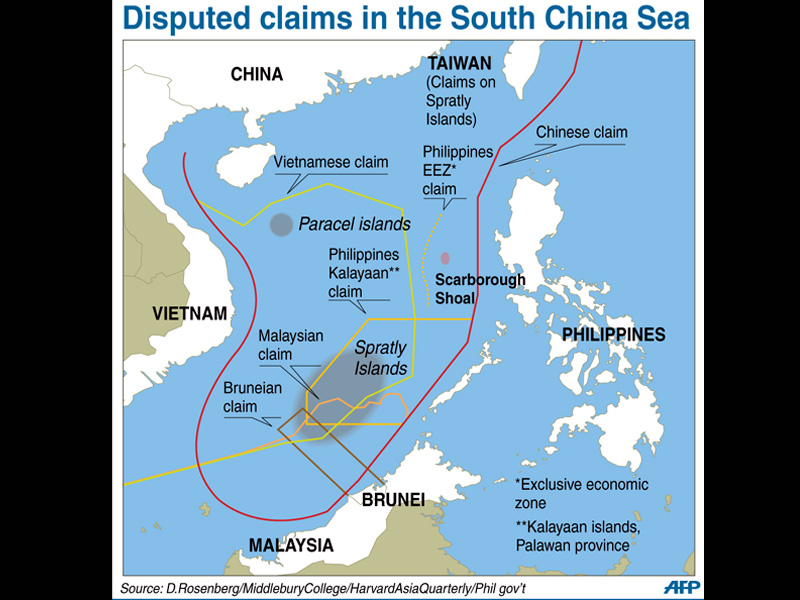
Map showing the disputed areas in the West Philippine Sea (south China Sea), including the Spratlys Islands and Scarborough Shoal. AFP
Quoting US Senate Resolution no. 412, Communications Secretary Herminio Coloma Jr. on Sunday said the US reaffirmed “its unwavering commitment and support for allies and partners in the Asia-Pacific Region, including long-standing United States policy regarding Article V of the United States-Philippines Mutual Defense Treat.”
Coloma explained that the resolution showed the US’ support for arbitration and peaceful settlement of disputes in West Philippine Sea (South China Sea), as well as its approval of Philippines’ actions.
“The Republic of the Philippines properly exercised its rights to peaceful settlement mechanisms with the filing of arbitration case under Article 287 and Article VII of the Convention of the Law of the Sea in order to achieve a peaceful and durable solution to the dispute,” the resolution said.
Coloma said Section 1 of the resolution clearly “condemns coercive and threatening actions or the use of force to impede freedom of operations in international airspace by military or civilian aircraft, to alter the status quo or to destabilize the Asia-Pacific Region.”
The Philippine official assured the people that the government would continue to pursue diplomatic options while maintaining dialogue with its Southeast Asian neighbors and allies.
Read more: http://globalnation.inquirer.net/107868/palace-welcomes-us-senate-resolution-backing-ph-on-sea-dispute#ixzz39u81WQ9f
Follow us: @inquirerdotnet on Twitter | inquirerdotnet on Facebook
Thursday, June 26, 2014
Road to Asean 2015: Cebu boosting its business sector’s competitiveness
THROUGHOUT history,
Cebu City has already had the honor of having many “firsts.” Established
by Miguel Lopez de Legazpi in 1571, it became the first city in the
Philippines, ahead of Manila by seven years. It is the oldest city in
the country, having the oldest and smallest fort (Fort San Pedro), the
oldest church (Basilica of Santo Niño), the oldest school (University of
San Carlos), and even the oldest street (Colon Street).
source: Business Mirror
Today the Queen City
down South boasts not just of its rich history but also of being the
only city in the Philippines with the perfect blend of a business
center, a leisure destination and a global events venue.
It started back in the
19th century, when the Island of Cebu had its rich and colorful
metamorphosis, which allowed it to exercise a dominant role in the
Philippines’s economic limelight. Because of its topography, agriculture
mainly pushed Cebu into an economic success. But even more fundamental
than the agricultural products was its participation in commerce. At
present, Cebu has only further demonstrated its economic capability with
an excellent track record—for instance, its growth rate on export
items, such as furniture, fashion, accessories, gifts, toys and house
wares, has averaged close to 20 percent, considerably higher than that
of any other province in the Philippines for the past five years.
This growth is
credited to the fact that the island is the most accessible place in the
Philippines, with more domestic air and sea linkages than any other
city in the country. In fact, it is the base of over 80 percent of
interisland shipping capacity in the Philippines.
Early this year Cebu
City was ranked eighth in the 2014 Top 100 Outsourcing Destinations
Report of Tholons, a US-based services globalization and investment
advisory for global outsourcing and research firm. It was able to beat
other high-profile locations in Europe, just trailing influential cities
as Bangalore, Manila, Mumbai, Delhi, Chennai, Hyderabad and Pune.
As it expands retail
establishments and welcomes a variety of global brands, Cebu City,
along with Manila, has been considered as a top city for retail
investments in the world. This was cited in a recent study by the Urban
Land Institute and PricewaterhouseCoopers, titled “Emerging Trends in
Real Estate Asia Pacific.”
Cebu City and the
whole of Cebu Island is also the tourism gateway for the Central and
Southern Philippines. It is a favorite vacation spot both by Filipinos
and foreigners for its world-class resorts, beautiful beaches, offered
leisure activities and laid-back lifestyle. The whole island has one of
the best records for peace and order in the country.
Moreover, the
development of Cebu’s infrastructure is stable. It has all the
ingredients necessary to be competitive and to sustain investments. It
is considered a cosmopolitan area with all the support facilities and
amenities for an ideal modern lifestyle, yet it is still more serene
than Metro Manila. This is why Cebu has become among the favorite hosts
of countless global occasions.
Property developers
has also been experiencing inventory shortage because of a very high
demand for middle-market condominium units, especially those that are
around P60,000 to P75,000-per-square-meter range. As the
market—including overseas Filipino workers and foreign nationals who
are looking to buying properties here for retirement—demands for
property, there is also a big clamor for developers to develop more
projects. This, despite the fact that most developers in the city offer
midrange products.
This boom in real estate is due to the flourishing of the tourism industry, according to realty experts.
With the much-needed
support from the government, especially in terms of roads and
infrastructures, Cebu might see an even bigger boom in the real-estate
industry.
In fact, the
government is being trapped to support the five strongest industries in
Cebu—shipbuilding, agricultural products, business-process outsourcing
(BPO), human capital that includes academe, and tourism—to make it more
competitive, especially with the upcoming Asean economic integration,
according to Asian Institute of Management executive director Ronald
Mendoza.
Mendoza said Cebu is
already very competitive, but the government can help even more by
creating policies that will support and promote these industries.
Particularly, he proposed maintaining an active dialogue between the
public and private sector to ensure that Filipino businessmen will be
able to seize more opportunities in the integration.
Likewise, assistance
to small to medium enterprises should also be given to help them achieve
competitiveness and be ready for the integration.
Cebu Business Month 2014
THIS whole month of
June, Cebu celebrates its thriving business sector’s global competence.
The Cebu Business Month (CBM), which is hosted annually by Cebu’s
premier business association, the Cebu Chamber of Commerce and Industry
(CCCI), is a venue used to showcase Cebu, as well as introduce its
programs, thrusts and advocacies.
CBM 2014 overall
Chairman Felix O. Tiukinhoy Jr. said during the launch of the
celebration that CCCI, as a business organization, has weathered not
only the ups and downs of business but also the test of time— the 111
years of the chamber’s history are closely linked with that of the city
and province of Cebu. He added that the flip side of challenges are
opportunities specifically from neighboring nations, and these are the
very reasons for this year’s CBM, which centers on what the economic
integration of the 10 member-countries of the Association of Southeast
Nations (Asean) in 2015 will bring to Cebu.
“Our collective
existence as a chamber is a key driver to national development and
progress. Our members have put forward the example of responsibility
and dynamism in the face of challenges, which now come in the form of
the Asean 2015 integration,” Tiukinhoy said.
CCCI President Ma.
Teresa Chan also cited that despite the two disasters that hit the
Visayas region last year, the chamber has only been made more inspired
to make the month-long event even bigger and bolder this time.
“CCCI will continue to
support the trade and industry in Cebu for a sustainable progress, and
we hope to create more jobs, reduce poverty and improve the lives of
the Cebuanos,” said.
This year’s activities
focus on improving the different industries of information and
communications technology (ICT), tourism and investment promotion, BPO,
creative industries and entrepreneurship. All programs are aimed to
address issues faced by the various sectors when the Asean becomes an
integrated economic community in 2015.
Among the major events
was Tourism and Investments Night, where recognition of Cebu’s top
investors and business champions was held—a first for CCCI to give
special recognition to groups and persons who helped boost Cebu as a
major global tourism and investment destination.
Event committee
Chairman Sabino Dapat said each awardee showed cooperation, while being
on top of competition can help a community. Ayala Group, one of the
awardees, was particularly commended Dapat for helping Cebu’s economy
through the two districts it developed, which is now “home to diverse
enterprises,” including ICT/BPM industry.
For the ICT and BPO
industry, CCCI has organized the 2014 Cebu ICT / BPO Conference and Expo
on June 2 and 3 at the Marco Polo Plaza Hotel.
It was a conference
that promoted Cebu’s standing as a leading global ICT and BPO hub. It
discussed issues, benchmarks and trends in the ICT and BPM industry;
shared opportunities and information among established and emerging ICT
and BPM hubs; and highlighted investment opportunities and local
technopreneurship, particularly in Cebu. It also discussed how the
growth of this sector could be sustained if it is linked with other
thrusts of Cebu—creating a network of stakeholders toward a unified
effort elevating Cebu to a more exciting and powerful altitude.
A Tourism and
Investment Forum Program, on the other hand, was held on June 19, also
at the Marco Polo Plaza Hotel. Among the points highlighted during the
event were the Increasing Competitiveness for Inclusive Growth Program,
which enables employment generation through increasing competitiveness
in the economy; and the Local Governance Support Program for Local
Economic Development, which aims to reduce poverty by strengthening
local governance and supporting sustainable local economic development.
It also talked about how sectors could raise the competitiveness of
Cebu’s Mactan, considering that it has so much potential for tourism.
Finally, the delegates discussed about sustainability and resiliency in
Cebu’s tourism industry through a “greening” strategy.
Meanwhile, the third
Creative Industries Summit showcases Cebu’s capabilities to integrate
creativity and good design into industries and other aspects of
business. It is an ongoing vibrant celebration of Cebu’s creative
resources through various exhibits, competitions and fora—invigorating
Cebu’s business community.
Finally, the CBM 2014
Entrepreneurship is being held for small and medium entrepreneurs to
have an awareness of the implications of the Asean Economic Integration,
and for them to develop specific business plans to mitigate threats
while taking advantage of opportunities.
In relation to this
cause, marketing guru Ned Noberto earlier this month had a talk to
encourage Cebu homegrown businesses to go beyond the borders and become a
national player. In succession to this, another forum on how a Filipino
business could potentially become a global company was held on June 18.
On June 24 the basics of successful exporting were discussed in a
forum.
source: Business Mirror
Subscribe to:
Posts (Atom)